
No products in the cart.
Education
Will THCa Show Up on a Drug Test?
24
Oct
Oct
If you have a workplace, probation, athletic, or other drug test coming up, do not guess. If you smoke, vape, dab, or cook THCa flower, treat it exactly as you would THC for drug-testing purposes. No source — and no product label — can guarantee you will pass after using THCa. Standard tests do not usually screen for THCa itself; they screen for what your body makes after THC, and heated THCa becomes THC before it reaches your bloodstream. This article is informational only, not medical or legal advice.
What Drug Tests Actually Look For
Most urine tests — the most common workplace screen — look for THC-COOH (11-nor-9-carboxy-THC), an inactive metabolite your liver produces after processing delta-9 THC. It is fat-soluble, stored in body fat, and released gradually, which is why it can be detected long after effects end.
Weedmaps, SAMHSA-based cutoff summaries, and multiple THCa guides agree on the standard federal workplace thresholds used in the United States:
- Initial immunoassay screen: 50 ng/mL for marijuana metabolites in urine
- Confirmation test (GC-MS or LC-MS/MS): 15 ng/mL for THC-COOH
A sample below the initial cutoff is reported negative; above it, it goes to confirmation. Not every program uses the federal cutoffs — some use lower thresholds — so do not treat 50 ng/mL as a safe target. Crucially, a test cannot tell where THC-COOH came from: from hemp-derived THCa or state-licensed cannabis, it is the same molecule to the lab.
The Chain: THCa → THC → THC-COOH
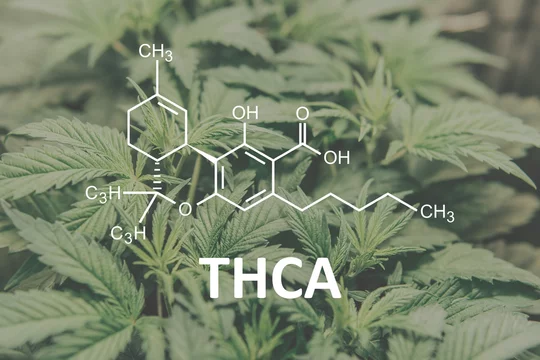
THCa (tetrahydrocannabinolic acid) is the raw, non-intoxicating acid form in fresh flower — see THCa vs THC and Does THCa get you high?
Heat changes everything. Smoking, vaping, dabbing, or baking applies enough heat for decarboxylation — THCa loses its carboxyl group and becomes delta-9 THC. The body then follows the same pathway as with any THC:
- THCa is heated and converts to delta-9 THC.
- The liver metabolizes THC, including through 11-hydroxy-THC.
- The end metabolite, THC-COOH, is stored in fat and excreted gradually, mainly in urine.
That chain is why the question is not really “do tests detect THCa?” It is “did the THCa you used become THC?” For smoked or vaped flower, the answer is yes.
Does It Matter How You Consumed THCa?
Smoked, vaped, dabbed, or cooked: high risk
Every THCa-specific source reached the same conclusion: heated THCa carries essentially the same risk as cannabis. A lighter, vape coil, dab rig, or oven decarboxylates it quickly. If you smoked THCa flower, assume THC-COOH will be produced.
Raw, unheated THCa: lower risk, not zero risk
Raw THCa in an unheated tincture, capsule, or juiced preparation is the one area where sources describe lower risk, because without heat much of it stays in acid form. Lower is not zero, and no source guarantees a negative result. Reasons include:
- Some conversion during drying, curing, storage, or processing.
- Trace delta-9 THC within a product’s legal limit, which still contributes metabolites, especially with repeated use.
- Varying test sensitivity and individual metabolism.
If passing is essential for your job, housing, freedom, or eligibility, do not rely on the raw-use distinction. The only approach sources consistently describe as reliable is not using the product before the test.
To read a product’s actual contents, see how to read a cannabis COA, including total THC: (THCa × 0.877) + delta-9 THC.
How Long Can THC-COOH Be Detected?
Detection windows are ranges, not deadlines. They vary with amount, frequency, body fat, metabolism, hydration, potency, and cutoff. Published ranges overlap broadly like this for heated THCa / THC:
| Test type | What it mainly detects | Typical window described in sources |
|---|---|---|
| Urine | THC-COOH | About 1–3 days after a single use; several days to about 10 days for occasional use; 15–30+ days for daily use, and longer for heavy long-term use |
| Blood | Active THC and metabolites | Hours to about 1–2 days for occasional use; up to several days, sometimes cited up to 7 days, for frequent use |
| Saliva / oral fluid | Parent THC, recent use | About 24 hours to 72 hours in most sources, occasionally longer for frequent use |
| Hair | Metabolites embedded in hair | Up to about 90 days; hair generally reflects a longer history, not recent use in the last few days |
Use these as rough orientation, not a countdown. Two people who used the same product on the same day can clear at different rates, and a more sensitive test can detect for longer. An exact “you will be clean on this day” promise goes beyond the evidence.
“But THCa Flower Is Legal Hemp — Does That Protect Me?”
No. Legality and drug testing are separate systems.
Under the 2018 Farm Bill, hemp is defined federally as cannabis with no more than 0.3% delta-9 THC by dry weight. That is about plant material as tested, not what happens after you heat it, nor what a workplace test measures. State laws vary: some apply a total-THC standard or restrict THCa flower. A drug test does not check Farm Bill status — it checks for THC-COOH. As sources put it, “hemp-derived” is a legal description, not a metabolic shield. An employer, court, or program may also have its own policy regardless of hemp law — check it directly.
Browse our shop, including Hi-T THCa Flower — no listing changes the position above.
If You Have a Test Coming Up
This guide will not recommend detox products, dilution tricks, or substitutes. Sources agree such products are unreliable, some programs treat attempts to cheat as a failure or separate violation, and none changes the metabolite facts. The honest steps are:
- Stop using heated THCa and THC products as early as possible.
- Do not assume a home test guarantees a laboratory result — cutoffs and methods can differ.
- If you are in a formal program, follow its disclosure rules and get advice from the program or a qualified professional, not a product page.
- If the stakes are high, get situation-specific advice before the test, not after a positive result.
The Bottom Line
Standard tests look for THC-COOH, not raw THCa. Heated THCa becomes THC, THC becomes THC-COOH, and that metabolite can be detected in urine for days to weeks, in blood and saliva for shorter windows, and in hair for up to about 90 days. Raw THCa is lower risk, but never zero and never guaranteed. If you cannot afford a positive result, treat THCa flower as THC — once heated, that is what your body and the test are dealing with.
Frequently Asked Questions
Will THCa show up on a urine drug test?
THCa itself is not what a urine test screens for — THC-COOH is. If you heated THCa, it converted to THC and will produce THC-COOH, so a positive result is expected as with cannabis. Duration depends on frequency and individual factors.
How long does THCa stay in your system?
For heated THCa, use THC windows as your guide: urine is commonly cited at 1–3 days after a single use, up to about 10 days for occasional use, and 30 days or more for daily or heavy use. Blood and saliva windows are much shorter, and hair can reflect use for up to about 90 days. These are ranges from published sources, not guarantees for any individual.
Can a drug test tell THCa apart from marijuana?
No. Once heated THCa becomes delta-9 THC, the metabolite produced — THC-COOH — is identical regardless of whether the source was hemp-derived THCa flower or marijuana. Standard tests do not distinguish the source.
Will raw, unheated THCa cause a positive test?
Sources describe lower risk than heated THCa, because raw THCa largely stays in acid form. It is not zero: trace THC, conversion during processing and storage, and test sensitivity mean no guarantee. Do not bet a required test on this distinction.
21+ only. This article is for general information only and is not medical or legal advice, and it does not guarantee any drug-test outcome. Cannabis and hemp laws and workplace policies vary — check your local regulations and your testing program’s policy.
